Showing posts with label 2016 Presidential Election. Show all posts

Saturday, August 11, 2018

The Blanket Coverage of Trump's Sins

New York Times
columnist
Thomas Friedman
Thomas L. Friedman's latest New York Times op-ed, "Keep Up the Blanket Coverage of Trump. It Hurts Him," prescribes the wrong fix for our ailing democracy. Mr. Friedman's premise: "Just a little wave of disgust among Republican moderates is all that is needed to turn several key states from red to blue."

His prescription (aimed mainly at those in the news media who decide what material gets covered the most): Don't stop the ongoing vituperative coverage of everything the president does wrong and everything he cruelly and falsely utters.

Mr. Friedman's hope: " ... there are decent Republican moderates who, while they may never pull the lever for a Democrat, just might get too disgusted to vote. It’s the best hope."

Too disgusted to vote??? Don't pull any electoral levers at all, if you feel you can't tolerate Trump and refuse to vote Democratic??? The recommendation is itself undemocratic. In itself, if carried out, it would further wound our democracy.

Moreover, Mr. Friedman's logic is self-refuting. He says there has indeed been ongoing blanket coverage of Trump's neverending faux pas. No one would challenge this fact, I agree. Yet in the latest RealClearPolitics average of polls, Trump still has a personal approval rating of 43 percent.

Trump's job approval ratings since he took office in January 2017 are shown by the lower black line in this graph:


They're right where they were just after his inauguration! Though they've leveled off in the last couple of months, in the first half of 2018 they have even climbed, after having bottomed out at 37 percent last December!

So the incessant bad press hasn't really hurt Trump.

Mr. Friedman says, in what I consider a tellingly weak argument:

I want all of this heard and spread from sea to shining sea. Because though [Trump's words of "bullying arrogance"] do rally Trump’s base, they also rally Democrats and evidently embarrass Republican moderates and alienate independents.

The veteran pollster Stanley Greenberg told me that he’s seeing signs of this is in his recent focus groups: One was with moderate Republicans, all of whom “were put off’’ by Trump’s behavior, and another was with “secular conservative Republicans,’’ half of whom were put off.

Overall, it seems the ongoing vituperativeness of most of the media coverage toward Trump has had marginal impact on G.O.P. voters, if only half of secular conservative Republicans have been "put off." Mr. Friedman continues:

In addition, Greenberg said, the full Trump — insulting black sports heroes, threatening conservatives who dare cross him, praising Vladimir Putin and attacking the F.B.I. — “reminds evangelical conservatives of the devil’s bargain they made in supporting him. Seeing him in all of his overreach and mania and self-absorption doesn’t make them second-guess their choice, but it makes them uncomfortable about it.’’

Just "uncomfortable"? Just "put off"? The continuing assault of our rational media upon our irrational president hasn't shown itself to be a great strategy, I'd say. So now the best prescription is: if you're not a confirmed Democrat but are uncomfortable with and put off by Trump, just don't vote?

No, I say, that is the worst sort of prescription, if we want to save our democracy. We need to find a way to convince as many as possible of the 40-45 percent of the electorate who continue to form Trump's base to abandon him at their polling places. We need to convince those who cast no vote at all in the 2016 election, and those strong Democrats who might otherwise fail to vote this November, to come out and vote against Trumpism. Let's maximize voter turnout, not minimize it!


Monday, May 21, 2018

"The Great Awakening"?

Salena Zito
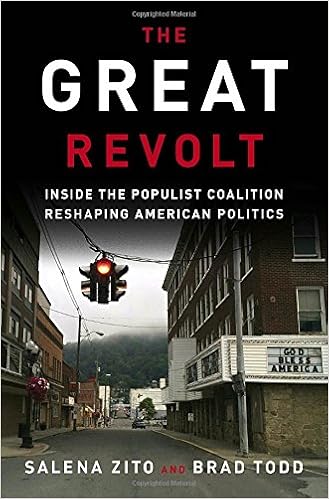
Maybe Salena Zito and Brad Todd's new book The Great Revolt should have been called The Great Awakening.

The book profiles numerous voters in Rust Belt states like Pennsylvania, Ohio, Michigan, Wisconsin, and Iowa. Many of these voters voted for Donald Trump in the 2016 presidential election, despite having voted for Barack Obama in 2008 and 2012. The specific localities the interviewees lived in — shown in darker shades of red in the map below — tipped those states into the "red" Republican column by large or slender margins in their statewide vote counts:


Here's the national electoral map for the 2016 presidential election:


Pennsylvania, Ohio, Michigan, Wisconsin, and Iowa had all been "blue" Democratic states in the 2008 and 2012 presidential elections. In 2016, they went "red."

The voters who swerved to put Trump over the top in these states in 2016 fit into seven categories, say Zito and Todd:
  1. "Red-Blooded and Blue-Collared" - Trump voters who had worked a blue-collar, hourly wage, or physical-labor job after the age of twenty-one, and had experienced a job loss in the last seven years either personally or in their immediate families.
  2. "Perot-istas" - similar to the group of voters who in 1992 propelled another iconoclastic billionaire candidate for president, Ross Perot, in his run for the presidency.
  3. "Rough Rebounders" - voters who had experienced a setback in life and saw the same kind of vulnerability and recovery in Trump as they had experienced.
  4. "Girl Gun Power" - women under the age of 45 who composed the one demographic group among Rust Belt Trump voters most likely to say "every American has a fundamental right to self-defense and a right to choose the home defense firearm that is best for them."
  5. "Rotary Reliables" - college-educated voters in counties farther away from major cities than most of the forty-four mega-counties in the nation with populations over one million that preferred Hillary Clinton. 
  6. "King Cyrus Christians" - evangelical and fundamentalist Christians and conservative Catholic voters.
  7. "Silent Suburban Moms" - women who secretly voted for Trump, even though conventional wisdom said they would vote for Hillary Clinton in deference to her image as the woman who could break the "glass ceiling."

That's quite a diverse group. What, if anything, did those voters have in common?

Fair warning: I've covered only the first four categories so far in my reading. But voters in those four "archetypes" do seem to have a lot in common. They all seem to see Trump, for instance, as "telling it like it is" rather than being mealy-mouthed like (say the Trump admirers) every other politician.

*****

I'm particularly taken with the "Girl Gun Power" group, though. Conventional wisdom would seem to say that few women want to own and carry guns. But these authors show that that isn't so. Lots of women in Rust Belt states like these five have concealed-carry permits and walk around locked and loaded. Some of the women use guns for hunting. Many of them prefer target shooting. All of them carry firearms mostly for personal protection.

Said one of the "Girl Gun Power" interviewees: "It’s smart, it’s empowering, it reminds me I am in charge of taking care of myself and my family at all times." So it seems that feminism's narrative of female empowerment has coalesced, at least in some minds, with the National Rifle Association's claim that guns should stay legal, if only for reasons of personal self-defense.

Another of Zito and Todd's gun-toting interviewees said:

Protecting [gun] rights ... clinched her vote for Trump. "There really was no other choice. Remember, this vote was for us. How can you not continue to vote for yourself, your family, your community to move forward? I think many of us did in the past and we finally looked up and said, 'What is happening in this is more than politics, this is culture and values, and it is everything.' Politics was just the thing making the most noise, and while it is hard to remember every detail of that election, one thing not hard to remember is this was like …

[The interviewee] struggles with the description, as if there isn’t an adequate word to describe it. [The word "awakening" is suggested.]

"Yes, an awakening," she says. "There were so many emotions during that election and they still continue, hard to remember all of them, but yes, like an awakening.

That's why I say Zito and Todd's book could have been titled The Great Awakening. A lot of the voters who swerved from Obama into the Trump camp weren't so much in full-fledged revolt as — or so they felt — in a state of having been newly awakened to long-dormant concerns about "culture and values, and ... everything."


*****

Despite the above, Democrats can take heart if:

  • Enough of these "swerve" Trump voters swerve back in the 2018 midterms and the 2020 presidential election, or
  • Enough of them stay home and fail to vote in those elections, or
  • Enough voters who prefer Democrats but who sat out the 2016 election show up at the polls in 2018 and 2020


My prediction is that — see "Closing in on Chaos" — no prediction is possible. I think the "Great Awakening" has moved our politics very close to a chaotic dynamics whose electoral outcomes are going to be at the mercy of a "butterfly effect." As I said before, some tiny, unforeseeable perturbation may make Democrats' dreams come true. On the other hand, an equally minute perturbation might boost Trump's Republicans into even greater power than they possess now, at state and local levels as well as nationally.


Saturday, May 19, 2018

More on "The Great Revolt"

I’m still reading The Great Revolt by Salena Zito and Brad Todd. Their interviewees from crucial upper midwestern/Great Lakes states who went for Trump had mostly been Obama voters ... twice! They flipped allegiances in 2016.

The interviewees all had rationales that most of us progressives would call crazy but that they themselves thought of as extremely sensible. They all forgave Trump — or even lionized him — for things we progressives find inexcusable. Yet none of the interviewees are people most of us would think of as bad people. They’re average Americans. They’re not monolithic in their personal profiles and lifestyles, either, but come from 7 distinct archetypical categories the authors define. We progressives would probably like all of them if we met them, but we’d also feel as if we are unlike them. They all persist in supporting Trump, for example, and they all completely set aside the media criticisms of him.

Check out New York Times columnist Charles M. Blow's recent column, "A Blue Wave of Moral Restoration." Mr. Blow says "Donald Trump’s approval rating is rising." Yet he hopes we'll believe what I think he's being too optimistic about:

As a CNN analysis last month said: “ ... the Republican Party is in trouble heading into the midterm elections. If past trends hold, it is possible Democrats could see a double-digit swing in the average House district in 2018 compared with past elections.”

I see this as (pardon the armchair science) an instance of (political) "bifurcation," where bifurcation is a characteristic pattern that emerges in studies of "chaos theory." Such systemic bifurcations and splittings-apart, if they continue, can be precursors to chaos proper. Systems that are in chaos proper are prone to the "butterfly effect," in which microscopic perturbations lead to large-scale, unpredictable outcomes — as in "a butterfly beating its wings in Brazil can produce a tornado in Kansas."

That’s why I think Mr. Blow is too optimistic. Our politics is close enough to chaos that the outcomes of our coming elections may depend on the moods of butterflies ...

Tuesday, May 15, 2018

"The Great Revolt"

I'm starting to read a new book, The Great Revolt. By reporter Salena Zito and Republican strategist Brad Todd, the book gives us a fresh slant on why Donald Trump won his electoral victory over Hillary Clinton in the 2016 presidential election.

The book is recommended today in an op-ed by Washington Post contributing columnist Hugh Hewitt, "Here’s how to crack the electoral code." Hewitt is a nationally syndicated radio show host and author of the book The Fourth Way: The Conservative Playbook for a Lasting GOP Majority.

Zito and Todd have it that Trump won the electoral vote — though not the popular vote — by violating the political rules that were formerly agreed to by America's elites, whether liberal or conservative. Trump's iconoclastic style generated huge shifts among voters in Rust Belt states like Pennsylvania, Ohio, Michigan, Wisconsin, and Iowa. The affected localities in those states had gone fairly strongly for President Obama in 2012 and 2008; by 2016 they were going strongly for Trump.

The Americans who shifted their voting behavior in Trump's favor either had voted for Obama in 2012 and/or 2008, or had sat out those two elections.

Hewitt puts the overarching reason for the shift this way:

The key theme is status — a fundamental conviction that elites of the big four metropolitan powers of Los Angeles, Silicon Valley, Manhattan and Washington wore a collective, fixed sneer toward their lessers between the coasts. Midwestern swing voters felt, to use the cliche from sports, “disrespected.”

In 2008, Obama had said of many of these voters (including many who voted for him):

They get bitter, they cling to guns or religion or antipathy to people who aren't like them or anti-immigrant sentiment or anti-trade sentiment as a way to explain their frustrations.

Hillary Clinton said in 2016 that half of Donald Trump’s supporters belong in a “basket of deplorables” characterized by “racist, sexist, homophobic, xenophobic, Islamaphobic” views.

Both of those comments typify why voting behavior shifted so rapidly. Obama's insensitive comment didn't hurt him in 2008 or 2012, but Clinton's equally insensitive comment did hurt her in 2016.

Though I'm a progressive Democrat who voted for Clinton in the 2016 general election (and Bernie Sanders in the Maryland primary), I come from "flyover country" stock in America's heartland, and I fully understand why so many people shifted allegiances from "blue" Democrats to Trump Republicans in the last election.

*****

As I continue to read, I'm finding the book quite perplexing. The main part of the book is organized as a series of in-depth interviews of and discussions about individual voters who switched from voting Democratic in 2012 and 2008 to voting for Trump in 2016. The first source of my perplexity is how these white voters (all I've encountered so far are white) could have supported Obama and then, in a radical shift, voted for Trump.

We read the words of the interviewees, and also the comments of the authors, which do offer some explanations. The two interviewees I've read about so far come from areas in Pennsylvania and Wisconsin where folks lead increasingly hardscrabble lives because of recent economic changes. Many of the changes have to do with globalization, international agreements about trade and other matters, and similar things. But the interviewed Trump-shifters, as I'll call them, are not out-of-work. They're not poor. But they are aware that some sort of politico-economic tide that once favored people like themselves in communities like their own is swiftly running out.

However, a big part of the Trump-shift seems to have to do with the idea that these voters were reacting not just to their own adverse politico-economic fortunes but also to the disrespect that the voters sensed coming from America's plutocrats and elites.

These voters saw Hillary Clinton as being in the hip pockets of those plutocrats and elites, and they noted that she was unwilling or unable to do or say much to disabuse the Trump-shifters of their hostile reactions to her.

*****

At a deeper level, though, the fault line between blue-for-Democratic and red-for-Republican areas of the country seems to have lay squarely along the rift between well-educated Americans who work mainly with their minds and (often) less-well-educated (but not dumb) Americans who work mainly with their hands.

After the 2016 election, pundits who were in the first category hastened to speak of Trump voters in the second category in disparaging ways that implied they were "ignorant rubes." The Great Revolt shows, though, that they were neither rubes nor ignorant.

What perplexes me most is that progressive politicians and pundits have so far not seemed to be able to figure out what to do about this grievous phenomenon, which might be better labeled "the great divide" than "the great revolt."

*****

It's strange. The people who work with their hands were once the heart and soul of the Democratic coalition: unionized blue-collar industrial workers, farmers, tradesmen — people not very high on the economic totem pole, but ones who were usually able to eke out a decent living by working hard.

FDR
In the Great Depression of the 1930s, many of them were without work. Democratic President Franklin Delano Roosevelt was elected in 1932 in part because many of those who were suddenly hurting economically had broken faith with his predecessor, Republican Herbert Hoover.

My parents were married during the Depression. Neither of them had had a college education. My dad had nearly attended college, but when the right time came in the early 1920s, there was an economic downturn and my granddad, a baker who had learned his trade as a 16-year-old camp cook on a Montana cattle ranch, didn't have enough money for the tuition.

By 1935 or so, Mom and Dad had moved from Springfield, MO, to Washington, DC, so my father could join the United States Park Police. He was lucky to get that job. His getting it had depended in part on his having done well on some sort of written examination; he was a smart man. Though Mom was not terribly political, they were both Democrats and FDR supporters at the time.

As time went on, my father rose through the U.S.P.P.'s ranks all the way to chief. As one of the several chiefs of police in the Nation's Capital, he hobnobbed with members of Congress, foreign diplomats, and movers-and-shakers in general.

I never fully understood why Mom and Dad moved from being Democrats to becoming political independents and eventually voting Republican. Looking back, though, I realize it must have had something to do with the values they had brought with them to the East Coast from America's heartland. Somehow, even though their Washington social circles were filled with elite people of both major parties and from various foreign lands, they stayed "heartland" folks. By the 1960s, that fact seemed to lead to their breaking with the initiatives Democrats were propounding during the Kennedy and Johnson administrations.

My extended family continued to live in the heartland. Those relatives, I realized every time we visited them, simply had different "ways" about them than just about anybody I'd ever met in Washington, DC, or its suburbs. Once I was grown and out on my own, my parents hied back to Springfield to live in a house they built on land my Uncle Bowman and Aunt Tootsie (Mom's sister) had sold them, just down the hill from Bowman and Tootsie's house.

*****


So I've always had one foot in East Coast, elite values and the other foot in the values of our country's heartland.

I grieves me to say that some of those heartland values, at least in my father and mother's case, included an intensifying racial antipathy toward people who were called, back then, "Negroes." It seems to be the contention of the authors of The Great Revolt that racism and like forms of bigotry were not all that important in converting Obama voters to Trump voters in 2016. Yet it's hard for me to believe that there wasn't at least an undercurrent of ethnic bigotry within Trump's echelons. It's hard for me to accept as true what we're hearing so often now from Trump supporters — that they aren't racists, anti-feminists, homophobes, etc.

My dad, as a policeman and as a hunter, always had guns around our house. Second-amendment rights were not front-and-center back then, but today I'm sure he would be an NRA member.

Dad believed in individual initiative, not government handouts. Maybe that's another reason why he abandoned the FDR fold.

I'm also having trouble reconciling what I'm calling "heartland values" with the "Red-Blooded and Blue-Collared" designation — one of seven Trumpist "archetypes" that Zito and Todd pick out — of a number of their interviewees. The first interviewee in that particular section of the book is a retired union representative from the area around Wilkes-Barre, PA. He's a dyed-in-the-wool blue-collar guy.

I have no reason to suppose my parents were ever union supporters. One of my mother's sisters did marry a man who became an official in the Brotherhood of Railroad Something-or-Others. But then again, Mom's father had gotten his lifelong job as a strike breaker. The job involved working in a railroad roundhouse in Springfield, MO, but as far as I know he never joined a union.

Dad was never a union member, as his police force was not unionized until after he was promoted to chief. His father was not a union member. He was a baker who at one time owned his own bakery in Milwaukee. Though he later was forced by economic woes to move to Springfield and go to work for another baker, he would still have thought of himself as "management," I imagine, and would not have joined what was then called the Journeyman Bakers Union. (See the history of the Bakery, Confectionery, Tobacco Workers and Grain Millers' International Union here.)

Anyway, my feeling is that there is something about heartland values that lies deeper than such relatively minor differences as whether or not a person is, or ever has a chance to be, a union member. Donald Trump got elected in large part because those holding such deep-set heartland values got sick of electing politicians who didn't even understand them in any fundamental way.

*****