Friday, June 01, 2018

Dueling Planes of Concern

A big problem right now in our politics is that pro-Trump and anti-Trump sentiments stem from different "planes of concern."

In today's Washington Post, two op-ed pieces speak to one of those planes of concern. One is Michael Gerson's "Trump doesn’t just fail a moral standard. He enables cruelty and abuse." Mr. Gerson vilifies Trump on moral grounds for his racist and misogynistic statements and behavior. The columnist says:

It is one thing for public officials to fail a moral standard. That makes them human. It is something else to shift a standard in favor of cruelty and abuse. That makes them poor stewards of public trust.

In "Roseanne Barr should blame Trump most of all," Eugene Robinson says:

President Trump wants to create a safe public space for ugly, unvarnished, unambiguous racism, which he knows he can exploit for political advantage. This cynical and destructive ploy must not be allowed to succeed.

Mr. Robinson is, like Mr. Gerson, putting the immorality of Trump's doings above the huge list of things that many of the most crucial of Trump's voters placed atop their own concerns in 2016.

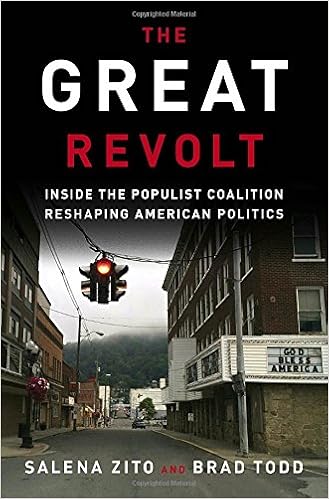
You can read about those voters' primary concerns in The Great Revolt: Inside the Populist Coalition Reshaping American Politics by reporter Salena Zito and Republican strategist Brad Todd. The people Zito and Todd interview all come from small communities in the Rust Belt states of Pennsylvania, Ohio, Michigan, Wisconsin, and Illinois. Their communities are just barely hanging on by their economic fingernails.

In 2016, those communities and their respective states flipped from "blue" ones voting Democratic — most of Zito and Todd's interviewees had voted for Barack Obama twice — to "red" ones voting Republican.

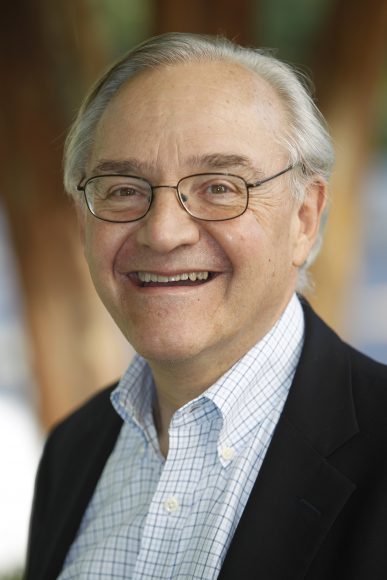
Brad Todd, center, and Salena Zito, right

The Zito/Todd interviewees were not represented by the authors as racists, misogynists, homophobes, or other kinds of bigots. Many admitted to having had a hard time deciding to vote for Trump, due to his quite apparent hostilities toward blacks, Hispanics, women, and, more generally, groups these voters had nothing against.

Yet these voters put their concerns about their local communities first. Their communities had, over the course of several decades, lost industries, jobs, population — and the recognition and respect of most Democratic office-seekers. Democrats such as Hillary Clinton were, in 2016, more interested in supporting the interests of sections of American society that have been historically maligned and oppressed than they were in addressing the needs of other groups — for instance, blue-collar groups who had historically voted Democratic.

The Zito/Todd interviewees were saying, in effect, "Yes, but what about us."

"We ourselves are," these voters were saying, "now the ones being maligned and scorned. We want our jobs back, and we also want to be seen once more as vital communities on the American scene. We want to be recognized and respected as such once again."

Those voters' primary issues, in my view, arise from different planes of concern than the ones Mr. Gerson and Mr. Robinson talk about in their columns. Those voters are mostly concerned with how they think they are being seen and treated by the rest of America. But the "choir" to whom Messrs. Gerson and Robinson are "preaching" today put the president's moral failings above the reasons why so many of Zito and Todd's Rust Belt voters gave Trump their votes.

There is a mismatch of planes of concern here, and until the mismatch is somehow resolved, America's politics will remain on the critical list.


Wednesday, May 30, 2018

David Brooks's Critique of Meritocracy

David Brooks
"We need to build a meritocracy that is true to its values, truly open to all," writes New York Times columnist David Brooks in "The Strange Failure of the Educated Elite."

Today's meritocracy, Brooks writes, replaced our "older establishment" — in which the status of our movers and shakers was based on birth, not talent — that "won World War II and built the American Century."

Following WWII, Brooks tells us, Americans' status became increasingly merit-based; yet the putative values of us post-WWII baby boomers in favor of ushering "formerly oppressed" groups into their fair share of the American Dream have atrophied. Boomers ascended America's economic and social ladder based on their individual abilities, but then they began to "use their intellectual, financial and social advantages to pass down privilege to their children, creating a hereditary elite that is ever more insulated from the rest of society."

But that's not Brooks's main point. His main point is that "the ideology of meritocracy itself" is flawed. It's flawed because it "encourages several ruinous beliefs":

  1. Exaggerated faith in intelligence
  2. Misplaced faith in autonomy
  3. Misplaced notion of the self
  4. Inability to think institutionally
  5. Misplaced idolization of diversity

Brooks's discussion of these five errors in today's thinking takes our minds into the region of the quite abstruse, so herein I'd like to try to unpack some of Brooks's ideas as best I can.

Exaggerated faith in intelligence refers to our tendency to judge ourselves and one another by the scores we achieve on I.Q. tests. Under the assumption that one's I.Q. equals that individual's potential for success, we think someone's I.Q. therefore equals his or her value to society. Yet, Brooks writes, "many of the great failures of the last 50 years, from Vietnam to Watergate to the financial crisis, were caused by extremely intelligent people who didn’t care about the civic consequences of their actions."

I'd modify that to say "didn’t care enough about the civic consequences of their actions." My belief is that the movers and shakers who brought us the war in Vietnam, Watergate, and the financial crisis often at least intended to be civic-minded in making their choices and undertaking their initiatives. Yet what they did hurt us instead of making us better off.

Misplaced faith in autonomy indicts boomers' emphasis on the "individual journey" that every modern-day person supposedly undertakes en route to hoped-for success in life. Sadly, too much individualism atomizes us. It separates the meritorious who do manage to get ahead from everybody else. It engenders "a society high in narcissism and low in social connection." So here we Americans are, living in our present moment.

Misplaced notion of the self is Brooks's way of talking about our unfortunate elevation of "achievement" over "character." (I'm put in mind that the Puritans who settled New England believed that becoming conspicuously wealthy was a sign of God's favor.) Yet Brooks says:

If you base a society on a conception of self that is about achievement, not character, you will wind up with a society that is demoralized; that puts little emphasis on the sorts of moral systems that create harmony within people, harmony between people and harmony between people and their ultimate purpose.

That quote is the place where Brooks gets to the kernel of his thinking. He wants us to conjoin morality, harmony in its various modalities, and "ultimate purpose." Later on he introduces the word telos, so I'll delay further discussion of this point until I mention ...

Inability to think institutionally: This refers to a loss of faith in our social, political, and economic institutions, many of which were built after WWII by the older establishment's movers and shakers; thus, we've become disenchanted with the postwar global order. But we've also come to disrespect older great institutions such as the U.S. Congress.

... and I'll also mention ...

Misplaced idolization of diversity: the newfound "diversity" in American life has to do with "widened opportunities [for] those who were formerly oppressed," and thus would seem to be entirely good. But diversity is not the be-all-and-end-all, Brooks says.

Here's where Brooks introduces the idea of telos, thereby pushing us off the edge of our metaphorical swimming pool and into that pool's intellectual "deep end."

Telos is an ancient Greek word meaning "end," "purpose," or "goal." Another idea the word expresses is "meaning" — under the assumption that the meaning of history and the end-purpose of all our striving are identical. That's why Brooks says that

... diversity is a midpoint, not an endpoint. Just as a mind has to be opened so that it can close on something, an organization has to be diverse so that different perspectives can serve some end. Diversity for its own sake, without a common telos, is infinitely centrifugal, and leads to social fragmentation.

In other words, our newfound insistence on fostering diversity and inclusiveness is a necessary "way station" en route to the telos which is our history's ultimate meaning. But that ultimate meaning, that telos, includes more than just diversity.

And so Brooks ends by saying:

The meritocracy is here to stay, thank goodness, but we probably need a new ethos to reconfigure it — to redefine how people are seen, how applicants are selected, how social roles are understood and how we narrate a common national purpose.

I fully agree. But I also wonder exactly what that new ethos — "the guiding beliefs or ideals that characterize [our] community, nation, or ideology — is going to have to be, and how we can go about forming that new ethos.


Monday, May 28, 2018

Recognition

The Great Revolt by reporter Salena Zito and Republican strategist Brad Todd documents why so many voters in small cities and counties in Pennsylvania, Ohio, Michigan, Wisconsin, and Iowa voted for Donald Trump in 2016, despite having supported Barack Obama and other Democrats in previous election cycles. The book was based on the authors' interviews with many such voters. The interviewees fell into seven quasi-distinct categories, but I feel they all embodied at least this one common characteristic in their Trump support: the notion that they were no longer getting recognized here in the country of their birth.

These were all middle-American white voters. They didn't fit the oft-repeated stereotype, though, of being racist, bigoted, misogynistic, homophobic, or anti-Semitic. Nor were many of them out of work or simply voting their pure economic interests.

But they all railed against what they perceived as a culture that had turned against them. The standard run of politicians, whether Democratic or Republican, no longer knew what they were all about. The powerful elites ignored or despised them. The purveyors of multiculturalism and tolerance didn't respect their culture or feel inclusive toward them.

I interpret this as a failure of recognition. We all, every one of us, want to be recognized by other humans as who and what we are. Recognized, that is, in the sense of being known and accepted as fellow human beings.

All of us humans have the same basic instincts and fundamental energies. From the point of view of certain psychological theories, these can be seen as inbuilt archetypes. For example, we all (whatever our gender) contain a Mother archetype that powers our ability to relate to our own mother and to be (actually or conceptually) mothers ourselves. We all have an inbuilt archetypal understanding of the Child, the Trickster, and (see the Bible story in Genesis) the Flood. (Yesterday at my location in Catonsville, Maryland, we had such a long, torrential downpour that nearby Ellicott City suffered severe flooding for the second time in three years.)

The list of archetypes that are built into the human unconscious goes on from there. Held in common by all of us, they undergird our conscious modes of belief and behavior. Yet they express themselves differently in different individuals and among different communities.

When our various modes of archetypal expression get too far apart, we tend to lose the ability to offer recognition to those whose archetypal energies express themselves differently than they do in our own individual lives and among our own accustomed communities. We act as if "we" and "they" exist in different "silos." And we may come to feel as if we ourselves have become "strangers in a strange land": as if the people in the other silos fail to encounter us as fellow human beings.


Sunday, May 27, 2018

Separate Moral Universes

I'm still reading The Great Revolt. The book by reporter Salena Zito and Republican strategist Brad Todd reports on interviews conducted by the authors in which their interviewees talk about why they voted for Donald Trump in the 2016 presidential election.

The interviewees all come from five Rust Belt states: Pennsylvania, Ohio, Michigan, Wisconsin, and Iowa. Four of those states are on at least one of the Great Lakes. All of those states gave the majority of their votes to Barack Obama in 2012, making them Democratic "blue" states back then and also in the more distant past. In 2016, they flipped into the Republican "red" column. The question the authors ask is, "Why?"

Their interviewees cluster into a few towns and counties in the five states in question. Those particular towns and counties themselves flipped for Trump in 2016 and were big factors in helping their states do the same.

The interviewees that I've encountered so far — I'm only about 2/3 of the way through the book — are fairly diverse in age, gender, whether or not they have been to college, whether or not they themselves have lost jobs due to economic woes. Some are evangelical Christians, but many don't put religion first in their lives. All of them are alike, it must be noted, in being white.

Yet none of them seem motivated, first and foremost, by racism or ethnic bias. Nor do any seem to be particularly sexist, homophobic, anti-Semitic, or prone to any of the other sorts of bigotry that Trump's resisters accuse the president of.

Other than their Caucasian race, what seems to unite the interviewees is their moral outlook. An example comes from one of the interviewees:

I ... felt from the first get-go of Obama was that the country’s sliding backwards. Government interference. Just, I almost want to say, a moral decay. This attitude of entitlement for people seemed to be getting worse and worse every year. The direction of the country really has me concerned. It was one of the driving forces for me in this election. Liberty, especially religious liberty, was always under attack. I felt like there was no one to protect people who held traditional values.

That man, Neil Shaffer, who happens to be an evangelical Christian, comes from a rural county in Iowa. He voted for Trump for a potpourri of reasons that are alluded to in that quote. To me, the key phrases are "moral decay" and "traditional values."

On the other hand, Renee Dibble from Ashtabula, Ohio, falls not into the authors' "King Cyrus Christians" category but into their archetypal "Rough Rebounders" group who have fought their way back from some unfortunate circumstance. In particular, Dibble is a breast cancer survivor. Here's part of the authors' discussion of Dibble:

Voting for Trump [say the authors] has changed Dibble. “I don’t see politics the same way anymore. Before, I saw it as this other thing, this thing I wasn’t part of, this club where I didn’t belong. And now I see it as a moral obligation, not just for myself and my family but for my community.”

Dibble is the mother of a large family, some of her and her police-detective husband's children being adopted and non-white. Dibble's mother was Protestant, her father Catholic; she herself does not seem to be religious. But as the quote above suggests, she has a definite moral stance that guided her toward voting for Trump.


*****

I read in The Washington Post and The New York Times countless opinion pieces lambasting Trump and all who support him. All of this anti-Trump opinion is at root, I think, based on moral outrage.

E.J. Dionne, Jr.
One of my favorite Post op-ed writers is E.J. Dionne, Jr. One of his recent columns is "Christian leaders call out the heresy of Trumpism." Dionne, my fellow Roman Catholic, has it that

This is a testing time for the country as a whole, but the moment presents a particular challenge to the Christian churches.

Trump, after all, won a substantial majority of the vote among white Christians. The battle within Christianity (and not just in the United States) can be defined in many ways. It is at least in part between those who would use faith as a means of excluding others on the basis of nation, culture and, too often, race, and those who see it as an appeal to conscience, a prod to social decency — and, yes, as an invitation to love.

The question “Who is Jesus?” has been debated for two millennia. It is starkly relevant now.

Reading The Great Revolt convinces me that Dionne is positing a false dichotomy here. In today's America, it's not a war between "faith as a means of excluding others on the basis of nation, culture and, too often, race" and, on the other hand, "those who see [faith] as an appeal to conscience, a prod to social decency — and, yes, as an invitation to love." Rather, it's a question of differing moral priorities.

Zito and Todd's interviewees, whether or not they characterize themselves as strong Christians, rank these moral imperatives near the top of their lists:


  • Liberty, especially religious liberty
  • Self-reliance, as opposed to an attitude of "entitlement" to things unearned
  • But also: giving more back to the local community than one has oneself received


The interviewees are all "givers," not "takers." Whatever their jobs happen to be, they are "makers," not just users and consumers. And many of them feel disrespected by the various politicians and opinion leaders who have vocally opposed Trump.

Many of the Zito/Todd interviewees had to, in effect, hold their noses as they voted for Trump. Despite Trump's many indiscretions and moral inadequacies, though, they nonetheless felt he understood them and respected them.

Mr. Dionne and most of the other Trump-opposing op-ed writers I like to read are just as conspicuously moral in their outlook as the Zito/Todd interviewees are. Yet, owing to putting a different set of moral imperatives at the top of their respective lists, they fail to understand and respect the seven main categories of voters that Zito and Todd say put Trump in the White House. These anti-Trump opinion writers come from a different "moral universe" than the Zito/Todd interviewees do.

Near the tops of the moral-priorities lists of these opinion leaders come such things as:


  • Racial and ethnic inclusiveness
  • Support for women's rights
  • Tolerance for abortion
  • Acceptance of gay marriage


Some of these are things that some of the Zito/Todd interviewees might also support. However, few of the interviewees would place them higher than such things as liberty in general and religious liberty in particular; an emphasis on self-reliance; communitarianism that does not intrude into individuals' private lives and beliefs; opposition to "moral decay"; support for "traditional values"; and so forth.

So the things splitting America in two politically today come down to manifesting two different sets of moral priorities. Whenever people do that, they can be equally moral, but they are living in two separate moral universes.


Monday, May 21, 2018

"The Great Awakening"?

Salena Zito
Maybe Salena Zito and Brad Todd's new book The Great Revolt should have been called The Great Awakening.

The book profiles numerous voters in Rust Belt states like Pennsylvania, Ohio, Michigan, Wisconsin, and Iowa. Many of these voters voted for Donald Trump in the 2016 presidential election, despite having voted for Barack Obama in 2008 and 2012. The specific localities the interviewees lived in — shown in darker shades of red in the map below — tipped those states into the "red" Republican column by large or slender margins in their statewide vote counts:


Here's the national electoral map for the 2016 presidential election:


Pennsylvania, Ohio, Michigan, Wisconsin, and Iowa had all been "blue" Democratic states in the 2008 and 2012 presidential elections. In 2016, they went "red."

The voters who swerved to put Trump over the top in these states in 2016 fit into seven categories, say Zito and Todd:
  1. "Red-Blooded and Blue-Collared" - Trump voters who had worked a blue-collar, hourly wage, or physical-labor job after the age of twenty-one, and had experienced a job loss in the last seven years either personally or in their immediate families.
  2. "Perot-istas" - similar to the group of voters who in 1992 propelled another iconoclastic billionaire candidate for president, Ross Perot, in his run for the presidency.
  3. "Rough Rebounders" - voters who had experienced a setback in life and saw the same kind of vulnerability and recovery in Trump as they had experienced.
  4. "Girl Gun Power" - women under the age of 45 who composed the one demographic group among Rust Belt Trump voters most likely to say "every American has a fundamental right to self-defense and a right to choose the home defense firearm that is best for them."
  5. "Rotary Reliables" - college-educated voters in counties farther away from major cities than most of the forty-four mega-counties in the nation with populations over one million that preferred Hillary Clinton. 
  6. "King Cyrus Christians" - evangelical and fundamentalist Christians and conservative Catholic voters.
  7. "Silent Suburban Moms" - women who secretly voted for Trump, even though conventional wisdom said they would vote for Hillary Clinton in deference to her image as the woman who could break the "glass ceiling."

That's quite a diverse group. What, if anything, did those voters have in common?

Fair warning: I've covered only the first four categories so far in my reading. But voters in those four "archetypes" do seem to have a lot in common. They all seem to see Trump, for instance, as "telling it like it is" rather than being mealy-mouthed like (say the Trump admirers) every other politician.

*****

I'm particularly taken with the "Girl Gun Power" group, though. Conventional wisdom would seem to say that few women want to own and carry guns. But these authors show that that isn't so. Lots of women in Rust Belt states like these five have concealed-carry permits and walk around locked and loaded. Some of the women use guns for hunting. Many of them prefer target shooting. All of them carry firearms mostly for personal protection.

Said one of the "Girl Gun Power" interviewees: "It’s smart, it’s empowering, it reminds me I am in charge of taking care of myself and my family at all times." So it seems that feminism's narrative of female empowerment has coalesced, at least in some minds, with the National Rifle Association's claim that guns should stay legal, if only for reasons of personal self-defense.

Another of Zito and Todd's gun-toting interviewees said:

Protecting [gun] rights ... clinched her vote for Trump. "There really was no other choice. Remember, this vote was for us. How can you not continue to vote for yourself, your family, your community to move forward? I think many of us did in the past and we finally looked up and said, 'What is happening in this is more than politics, this is culture and values, and it is everything.' Politics was just the thing making the most noise, and while it is hard to remember every detail of that election, one thing not hard to remember is this was like …

[The interviewee] struggles with the description, as if there isn’t an adequate word to describe it. [The word "awakening" is suggested.]

"Yes, an awakening," she says. "There were so many emotions during that election and they still continue, hard to remember all of them, but yes, like an awakening.

That's why I say Zito and Todd's book could have been titled The Great Awakening. A lot of the voters who swerved from Obama into the Trump camp weren't so much in full-fledged revolt as — or so they felt — in a state of having been newly awakened to long-dormant concerns about "culture and values, and ... everything."


*****

Despite the above, Democrats can take heart if:

  • Enough of these "swerve" Trump voters swerve back in the 2018 midterms and the 2020 presidential election, or
  • Enough of them stay home and fail to vote in those elections, or
  • Enough voters who prefer Democrats but who sat out the 2016 election show up at the polls in 2018 and 2020


My prediction is that — see "Closing in on Chaos" — no prediction is possible. I think the "Great Awakening" has moved our politics very close to a chaotic dynamics whose electoral outcomes are going to be at the mercy of a "butterfly effect." As I said before, some tiny, unforeseeable perturbation may make Democrats' dreams come true. On the other hand, an equally minute perturbation might boost Trump's Republicans into even greater power than they possess now, at state and local levels as well as nationally.


Sunday, May 20, 2018

Ireland's Ballot Measure on Abortion

On Friday, May 25, Ireland will vote on a ballot measure to repeal the Eighth Amendment to it's constitution, thus to allow the government to legalize abortion well beyond narrow cases involving threats to the mother’s life. Right now that amendment, passed in 1983, keeps "abortion on demand" from being legal.

Ross Douthat
New York Times columnist Ross Douthat, a conservative Catholic, writes of the Irish ballot measure here. He encapsulates his attitude this way:

... with its restrictive abortion laws, generous family policy and otherwise modern economy, Ireland seems to have achieved or maintained some notable pro-life and pro-family goals without compromising women’s health or female opportunities relative to countries with abortion on demand.

He cites much evidence that Irish women's health and their social and economic parity with men are indeed not compromised because Irish law restricts legal abortions. This fact challenges the dominant arguments made by feminists and those made by social conservatives. Feminists say that "female equality depends on abortion rights ... and the post-1960s achievements of women in the professional arena are impossible without it." Conservatives say that "serious abortion opponents must reject feminism entirely." Douthat says that what's happened in Ireland over the last several decades proves that such either-or thinking is wrong.

I hope Douthat is right, and I also hope Ireland does not repeal its Eighth Amendment. Why? Because although I think of myself as progressive on women's issues, I believe even progressives ought to accord human fetuses a right to life.


Saturday, May 19, 2018

More on "The Great Revolt"

I’m still reading The Great Revolt by Salena Zito and Brad Todd. Their interviewees from crucial upper midwestern/Great Lakes states who went for Trump had mostly been Obama voters ... twice! They flipped allegiances in 2016.

The interviewees all had rationales that most of us progressives would call crazy but that they themselves thought of as extremely sensible. They all forgave Trump — or even lionized him — for things we progressives find inexcusable. Yet none of the interviewees are people most of us would think of as bad people. They’re average Americans. They’re not monolithic in their personal profiles and lifestyles, either, but come from 7 distinct archetypical categories the authors define. We progressives would probably like all of them if we met them, but we’d also feel as if we are unlike them. They all persist in supporting Trump, for example, and they all completely set aside the media criticisms of him.

Check out New York Times columnist Charles M. Blow's recent column, "A Blue Wave of Moral Restoration." Mr. Blow says "Donald Trump’s approval rating is rising." Yet he hopes we'll believe what I think he's being too optimistic about:

As a CNN analysis last month said: “ ... the Republican Party is in trouble heading into the midterm elections. If past trends hold, it is possible Democrats could see a double-digit swing in the average House district in 2018 compared with past elections.”

I see this as (pardon the armchair science) an instance of (political) "bifurcation," where bifurcation is a characteristic pattern that emerges in studies of "chaos theory." Such systemic bifurcations and splittings-apart, if they continue, can be precursors to chaos proper. Systems that are in chaos proper are prone to the "butterfly effect," in which microscopic perturbations lead to large-scale, unpredictable outcomes — as in "a butterfly beating its wings in Brazil can produce a tornado in Kansas."

That’s why I think Mr. Blow is too optimistic. Our politics is close enough to chaos that the outcomes of our coming elections may depend on the moods of butterflies ...

Tuesday, May 15, 2018

"The Great Revolt"

I'm starting to read a new book, The Great Revolt. By reporter Salena Zito and Republican strategist Brad Todd, the book gives us a fresh slant on why Donald Trump won his electoral victory over Hillary Clinton in the 2016 presidential election.

The book is recommended today in an op-ed by Washington Post contributing columnist Hugh Hewitt, "Here’s how to crack the electoral code." Hewitt is a nationally syndicated radio show host and author of the book The Fourth Way: The Conservative Playbook for a Lasting GOP Majority.

Zito and Todd have it that Trump won the electoral vote — though not the popular vote — by violating the political rules that were formerly agreed to by America's elites, whether liberal or conservative. Trump's iconoclastic style generated huge shifts among voters in Rust Belt states like Pennsylvania, Ohio, Michigan, Wisconsin, and Iowa. The affected localities in those states had gone fairly strongly for President Obama in 2012 and 2008; by 2016 they were going strongly for Trump.

The Americans who shifted their voting behavior in Trump's favor either had voted for Obama in 2012 and/or 2008, or had sat out those two elections.

Hewitt puts the overarching reason for the shift this way:

The key theme is status — a fundamental conviction that elites of the big four metropolitan powers of Los Angeles, Silicon Valley, Manhattan and Washington wore a collective, fixed sneer toward their lessers between the coasts. Midwestern swing voters felt, to use the cliche from sports, “disrespected.”

In 2008, Obama had said of many of these voters (including many who voted for him):

They get bitter, they cling to guns or religion or antipathy to people who aren't like them or anti-immigrant sentiment or anti-trade sentiment as a way to explain their frustrations.

Hillary Clinton said in 2016 that half of Donald Trump’s supporters belong in a “basket of deplorables” characterized by “racist, sexist, homophobic, xenophobic, Islamaphobic” views.

Both of those comments typify why voting behavior shifted so rapidly. Obama's insensitive comment didn't hurt him in 2008 or 2012, but Clinton's equally insensitive comment did hurt her in 2016.

Though I'm a progressive Democrat who voted for Clinton in the 2016 general election (and Bernie Sanders in the Maryland primary), I come from "flyover country" stock in America's heartland, and I fully understand why so many people shifted allegiances from "blue" Democrats to Trump Republicans in the last election.

*****

As I continue to read, I'm finding the book quite perplexing. The main part of the book is organized as a series of in-depth interviews of and discussions about individual voters who switched from voting Democratic in 2012 and 2008 to voting for Trump in 2016. The first source of my perplexity is how these white voters (all I've encountered so far are white) could have supported Obama and then, in a radical shift, voted for Trump.

We read the words of the interviewees, and also the comments of the authors, which do offer some explanations. The two interviewees I've read about so far come from areas in Pennsylvania and Wisconsin where folks lead increasingly hardscrabble lives because of recent economic changes. Many of the changes have to do with globalization, international agreements about trade and other matters, and similar things. But the interviewed Trump-shifters, as I'll call them, are not out-of-work. They're not poor. But they are aware that some sort of politico-economic tide that once favored people like themselves in communities like their own is swiftly running out.

However, a big part of the Trump-shift seems to have to do with the idea that these voters were reacting not just to their own adverse politico-economic fortunes but also to the disrespect that the voters sensed coming from America's plutocrats and elites.

These voters saw Hillary Clinton as being in the hip pockets of those plutocrats and elites, and they noted that she was unwilling or unable to do or say much to disabuse the Trump-shifters of their hostile reactions to her.

*****

At a deeper level, though, the fault line between blue-for-Democratic and red-for-Republican areas of the country seems to have lay squarely along the rift between well-educated Americans who work mainly with their minds and (often) less-well-educated (but not dumb) Americans who work mainly with their hands.

After the 2016 election, pundits who were in the first category hastened to speak of Trump voters in the second category in disparaging ways that implied they were "ignorant rubes." The Great Revolt shows, though, that they were neither rubes nor ignorant.

What perplexes me most is that progressive politicians and pundits have so far not seemed to be able to figure out what to do about this grievous phenomenon, which might be better labeled "the great divide" than "the great revolt."

*****

It's strange. The people who work with their hands were once the heart and soul of the Democratic coalition: unionized blue-collar industrial workers, farmers, tradesmen — people not very high on the economic totem pole, but ones who were usually able to eke out a decent living by working hard.

FDR
In the Great Depression of the 1930s, many of them were without work. Democratic President Franklin Delano Roosevelt was elected in 1932 in part because many of those who were suddenly hurting economically had broken faith with his predecessor, Republican Herbert Hoover.

My parents were married during the Depression. Neither of them had had a college education. My dad had nearly attended college, but when the right time came in the early 1920s, there was an economic downturn and my granddad, a baker who had learned his trade as a 16-year-old camp cook on a Montana cattle ranch, didn't have enough money for the tuition.

By 1935 or so, Mom and Dad had moved from Springfield, MO, to Washington, DC, so my father could join the United States Park Police. He was lucky to get that job. His getting it had depended in part on his having done well on some sort of written examination; he was a smart man. Though Mom was not terribly political, they were both Democrats and FDR supporters at the time.

As time went on, my father rose through the U.S.P.P.'s ranks all the way to chief. As one of the several chiefs of police in the Nation's Capital, he hobnobbed with members of Congress, foreign diplomats, and movers-and-shakers in general.

I never fully understood why Mom and Dad moved from being Democrats to becoming political independents and eventually voting Republican. Looking back, though, I realize it must have had something to do with the values they had brought with them to the East Coast from America's heartland. Somehow, even though their Washington social circles were filled with elite people of both major parties and from various foreign lands, they stayed "heartland" folks. By the 1960s, that fact seemed to lead to their breaking with the initiatives Democrats were propounding during the Kennedy and Johnson administrations.

My extended family continued to live in the heartland. Those relatives, I realized every time we visited them, simply had different "ways" about them than just about anybody I'd ever met in Washington, DC, or its suburbs. Once I was grown and out on my own, my parents hied back to Springfield to live in a house they built on land my Uncle Bowman and Aunt Tootsie (Mom's sister) had sold them, just down the hill from Bowman and Tootsie's house.

*****


So I've always had one foot in East Coast, elite values and the other foot in the values of our country's heartland.

I grieves me to say that some of those heartland values, at least in my father and mother's case, included an intensifying racial antipathy toward people who were called, back then, "Negroes." It seems to be the contention of the authors of The Great Revolt that racism and like forms of bigotry were not all that important in converting Obama voters to Trump voters in 2016. Yet it's hard for me to believe that there wasn't at least an undercurrent of ethnic bigotry within Trump's echelons. It's hard for me to accept as true what we're hearing so often now from Trump supporters — that they aren't racists, anti-feminists, homophobes, etc.

My dad, as a policeman and as a hunter, always had guns around our house. Second-amendment rights were not front-and-center back then, but today I'm sure he would be an NRA member.

Dad believed in individual initiative, not government handouts. Maybe that's another reason why he abandoned the FDR fold.

I'm also having trouble reconciling what I'm calling "heartland values" with the "Red-Blooded and Blue-Collared" designation — one of seven Trumpist "archetypes" that Zito and Todd pick out — of a number of their interviewees. The first interviewee in that particular section of the book is a retired union representative from the area around Wilkes-Barre, PA. He's a dyed-in-the-wool blue-collar guy.

I have no reason to suppose my parents were ever union supporters. One of my mother's sisters did marry a man who became an official in the Brotherhood of Railroad Something-or-Others. But then again, Mom's father had gotten his lifelong job as a strike breaker. The job involved working in a railroad roundhouse in Springfield, MO, but as far as I know he never joined a union.

Dad was never a union member, as his police force was not unionized until after he was promoted to chief. His father was not a union member. He was a baker who at one time owned his own bakery in Milwaukee. Though he later was forced by economic woes to move to Springfield and go to work for another baker, he would still have thought of himself as "management," I imagine, and would not have joined what was then called the Journeyman Bakers Union. (See the history of the Bakery, Confectionery, Tobacco Workers and Grain Millers' International Union here.)

Anyway, my feeling is that there is something about heartland values that lies deeper than such relatively minor differences as whether or not a person is, or ever has a chance to be, a union member. Donald Trump got elected in large part because those holding such deep-set heartland values got sick of electing politicians who didn't even understand them in any fundamental way.

*****


Sunday, May 13, 2018

Closing in on Chaos


There's a useful article in this Sunday's Washington Post, "Loyalty, unease in Trump’s Midwest," subtitled "Voters gave Trump a chance. Some remain all in. Others have grown weary of the chaos." By longtime Post political reporter Dan Balz, it's an extended look at how opinion about President Trump has shifted — and how it hasn't — in parts of four upper-Midwestern states, two of which states helped put the current chief executive in office in the November 2016 presidential election.

Balz's interviewees were people in key counties and congressional districts in Iowa, Minnesota, Wisconsin, and Illinois. Most of the interviewees voted for Trump Those localities had a history, prior to 2016, of voting Democratic. This national map shows how so many of those localities are clustered around the upper Mississippi River:


The white areas on the national map above represent localities which went for Hillary Clinton in 2016. All the other areas, shown in pink or red, are localities that went for Trump. That they comprise an area far, far greater than that of those that supported Clinton in an election which saw Trump narrowly lose the overall popular vote is testimony to the fact that most of Clinton's voters came from cities and localities with much denser population concentrations than the areas which Trump won.

Here's the way the electoral vote broke in 2016:


Minnesota and Illinois stayed in the Democratic column they had occupied in 2012, but Iowa and Wisconsin, which had tipped toward Barack Obama in 2012, in 2016 supported the GOP candidate. If the results in Minnesota and Illinois had depended just on localities shown in dark red in the first map, those two upper-Midwestern blue states might likewise have flipped into the Trump column.


*****

In the Post article, Balz's interviewees mention a plethora of issues and concerns that (a) influenced their pro-Trump voting behavior in 2016 and (b) still influence the attitudes of many of the interviewees toward President Trump today.

My main reaction is one of wonder at the sheer number of issues and concerns that get mentioned in the interviews. I can't recall a presidency that, 16 months in, evoked such a wide diversity of concerns.

A thought experiment: pretend that, as you begin to read the Balz article, you've sharpened a brand new pencil so as to make a note of each distinct issue or concern mentioned by the interviewees. My guess is that you would have to sharpen that pencil over and over again, and by the end of the article it would have been sharpened down to a nub.

Now try to imagine doing the same for a similar article 16 months into the Obama presidency — or that of George W. Bush, or Bill Clinton's, or any of the other presidents before them. My hunch is that, as passionately as many people felt about particular concerns at those respective times, the number of those concerns would not have required nearly as many sharpenings of your hypothetical pencil.

*****

To me this suggests we're closer to political chaos than we've been in recent memory.

By chaos I mean the way scientists and mathematicians studying "chaos theory" define the term. In chaos theory, certain kinds of systems operate in a way that makes their future states fundamentally impossible to predict. These systems are among what the mathematicians call "dynamical systems" — systems that change in mathematically describable ways over time. Such systems can be orderly or chaotic, and they can move from order to chaos in response to various perturbations. Once they are in the chaotic regime, they are prone to the "butterfly effect": a small change in the current state of such a system can result in large-yet-unpredictable differences at a later date.

I think our political system is close to chaos, in that mathematical sense of the word. As one of Balz's interviewees so aptly puts it the next-to-last paragraph of the article, " ... no one can predict the future."

So many of the interviewees seem truly torn, now mentioning a lot more things that they don't like about Trump than those same people mentioned in earlier interviews. I feel some of the interviewees are presently on the edge of turning against Trump. Clearly, though, the slightest Trump-friendly event might reinstate their full support. This is why I think of the political situation as being very close to chaos.

I hear predictions from some of my fellow liberal Democrats that this year's midterms will constitute a "wave election." By this they mean that Democrats will do so well in November as to return control of the House of Representatives, and possibly even of the U.S. Senate, to Democratic hands. As a result, Democrats will be in good position to take back the White House in 2020.

I join my fellow progressives in hoping that's true. However, I really think the butterfly effect is what will decide the 2018 outcome. Some tiny perturbation may make Democrats' dreams come true. On the other hand, an equally minute perturbation might boost Trump's Republicans into even greater power than they possess now, at state and local levels as well as nationally.

Stay tuned. It's going to be interesting ... and unpredictable.


Monday, December 11, 2017

Required Reading for Democrats and Republicans

David Brooks
Our democratic republic's politics are foundering as never before. Why? Here are two analyses. The first comes from New York Times columnist David Brooks and asks why today's conservative Republicans are light years apart from the conservatives whom Brooks revered a few decades ago. In "The G.O.P. Is Rotting," Brooks says:

A lot of good, honorable Republicans used to believe there was a safe middle ground. You didn’t have to tie yourself hip to hip with Donald Trump, but you didn’t have to go all the way to the other extreme and commit political suicide like the dissident Jeff Flake, either. You could sort of float along in the middle, and keep your head down until this whole Trump thing passed. 
Now it’s clear that middle ground doesn’t exist ...

Read the rest of the column to learn more about why Brooks, a center-right pundit, is in a state of despair.

Thomas B. Edsall
In "Liberals Need to Take Their Fingers Out of Their Ears," New York Times columnist Thomas Edsall offers his own despairing analysis of why liberal Democrats such as the ones I personally support aren't much better off:

For the moment, the left is both stunned and infuriated by the vehement animosity it faces from red America ... Many Democrats continue to have little understanding of their own role — often inadvertent, an unintended consequence of well-meaning behavior — in creating the conditions that make conservatives willing to support Trump and the party he is leading.

Edsall quotes Karen Stenner, author of "The Authoritarian Dynamic," who Edsall says is "no fan of the president," to the effect that:

... liberal democracy’s allowance of these things [such as unfettered freedom, diversity, multiculturalism, etc.] inevitably creates conditions of “normative threat,” arousing the classic authoritarian fears about threats to oneness and sameness, which activate those predispositions ... and cause the increased manifestation of racial, moral and political intolerance.

I admit I find some of the discourse that Edsall cites in this column a bit too nuanced for my full comprehension. Yet since Trump's electoral upset in 2016, I've found myself thinking a lot about what Stenner calls "normative threat." It's a good explanation for what's happened in our politics of late. However, it's anything but clear to me what we liberal Democrats can do about it without backpedaling away from our current commitments and constituencies.

*****

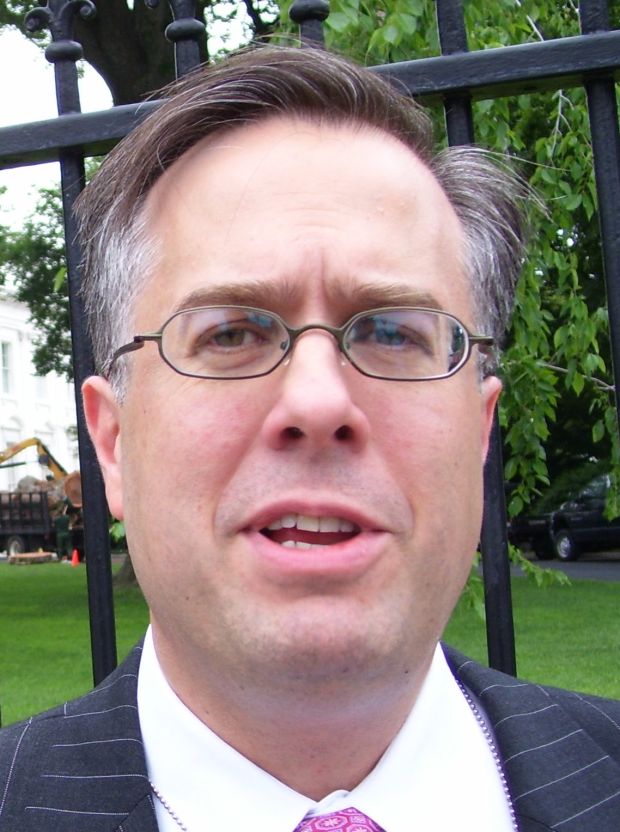
Roy Moore
Meanwhile, check out this Real Clear Politics polling aggregate page concerning tomorrow's special election in Alabama. There seems to be a lot of variability in the individual poll results between the two candidates vying to replace Jeff Sessions in the U.S. Senate. The Republican, Roy Moore, leads the poll aggregate by a whisker, +2.5 percent as I write this.


Doug Jones
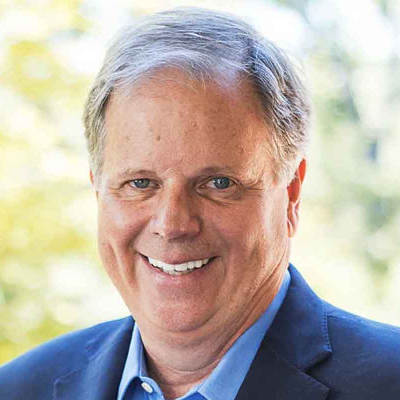
His Democratic opponent is Doug Jones. Given that Alabama is a solid-red state, the fact that Jones is even close in the polls surely has something to do with the allegations several women have made that Moore, then in his early 30s, had inappropriate sexual involvements with them when they were teenagers a few decades ago. If Moore does manage to eke out a victory tomorrow, it will mean that many of his supporters simply looked past his misdeeds ...


Saturday, December 09, 2017

"Movement" or "Moment"?

Gail Collins
Gail Collins writes in The New York Times of "The Great Al Franken Moment," in which there seems to be a tectonic shift going on. Women are claiming their power not to be sexually harassed by men without severe consequences for the men. A progressive Senate Democrat, Al Franken, is having to step down in view of his past transgressions. That's real change.

(Collins mentions the installation of a ladies' restroom in the 1860s in the A.T. Stewart Dry Goods Store in New York City. Alexander Turney Stewart — who knew he was a progressive on women's rights — was an ancestor of mine.)

Christine Emba
But Christine Emba writes in The Washington Post today ("Real change is taking root on sexual harassment. Unless it’s not.") of how she worries this Al Franken "moment" is just that: a moment, and not a movement.

A litmus test will be the outcome of Tuesday's special senatorial election in Alabama. Will the Republican candidate, Roy Moore, be able to edge the Democrat, Doug Jones? Moore has been credibly accused of pursuing teenage girls romantically and sexually several decades ago, when he was in his 30s. But he has great credibility with religious and political conservatives today. Emba says, and I agree, that Alabama voters should deny Moore a Senate seat because of his sexual past. All eyes will be on this race this week.


Sunday, December 03, 2017

Confession Is Good for the Soul, Pt. 1

As a 70-year-old male virgin (and how many of us can there be?) I want to make a public confession. When I was 20 and a junior in college in 1967 or '68, I committed what today might be called sexual harassment.

I had met a young woman at a university mixer. To my shame, I can't even remember her name now — so for ease of reference, I'll call her Karen. I asked Karen for her phone number and later called her for a date.

This was while I was a student at Georgetown University, and she was a student at a business college. The "scene" in the Georgetown part of Washington, DC, involved numerous bars and discotheques with live music and dancing. I took Karen to one of the nicer ones. We sat at a secluded table on a balcony overlooking the stage and dance floor, and we both had several drinks. When the urge struck me — again, to my shame — I commenced to grope her breast, sliding my hand underneath her bra.

Karen and I had one more date after that. It was a double date with my friend John S. and his girlfriend. We two couples ended up making out on the double twin beds in my dorm room.

My memory is hazy on what transpired between Karen and me after that ... until the Saturday afternoon when she called me at my family's home in Bethesda. She told me on the phone that she had recently attempted suicide.

Alarmed, I drove to her residence hall and picked her up. We sat in my car in front of the residence hall and talked about why she had tried to take her own life.

I regret to say that I remember little about our conversation. The reason for that was, I today think, that I was scared at potentially becoming responsible for, and to,  a suicidal girlfriend. I imagine I may have spoken words to that effect to her. After that, I never saw Karen again.

I imagine I also tried to console her, to a degree, during that last conversation. In addition to being one pathetic and immature guy, I was, after all, also empathetic. But never mind. I cut her loose.

Had her suicide attempt been a response to my having stopped calling her for dates? Regrettably, I don't remember. It may have been. If I maintain that it was, then I'm possibly guilty of inflating my own self-importance, no? But if I say it wasn't, I'm still guilty of having severed ties with a young woman who had phoned me for psychological support.

Karen, if you're out there and you recognize yourself in this story, I need to apologize. I hope you managed to find a long and happy life. I'm sorry I didn't treat you as well as you needed to be treated.


Monday, November 27, 2017

A "Rapport Revolution"?

Christine Emba
I'm grateful for Christine Emba's op-ed, "Let’s rethink sex," in today's Washington Post. Ms. Emba wants us men to prioritize building "rapport" with our potential sexual partners instead of merely obtaining "consent." It would pave the way for "a clearer, more boundaried sexual ethic" than we have now.

Beginning with the "sexual revolution" of the 1960s, our society has veered toward today's "hookup culture." It is now, says Emba, "America’s prevailing and problematic sexual ethic." Prior to the inception of the hookup ethic, "sexual encounters outside of marriage [were] disallowed or even discouraged." So we have swung from a maximally restrictive ethic to a minimally restrictive one. One result has been the ungodly frequency with which sexual assaults and incidents of harassment have been taking place over the past few decades.

Emba is saying we now need to move back toward the middle of the sexual-ethic continuum. We need what I might as well call a "rapport revolution." I heartily agree!


Sunday, November 26, 2017

The Male Libido ... Is It Brutal?

Stephen Marche
In "The Unexamined Brutality of the Male Libido" in the New York Times, Stephen Marche has it that: "For most of history, we’ve taken for granted the implicit brutality of male sexuality. ... How are we supposed to create an equal world when male mechanisms of desire are inherently brutal?"

I think Marche is wrong. Male "mechanisms of desire" are not "inherently brutal."

Yes, the recent upwelling of powerful men being credibly accused of sexual abuse against unwilling women shows that some men are sometimes brutal in their sexual expressions. Men "from Bill Cosby to Roger Ailes to Harvey Weinstein to Louis C.K. to Al Franken and ... Charlie Rose and John Lasseter" have indeed acted brutally at times. But I'd be willing to bet those same men have most often acted gently in expressing their libidos. So have virtually all of us men.

Yet the questions Marche implicitly raises are valid ones. Why do some men's sexual and romantic lives sometimes turn brutal? Is that happening more often today than it used to? (Keep in mind that most of the allegations against Weinstein et al. go back many years, even decades.) How can we men, starting right now, arrange for it to happen less often, en route to some virtual vanishing point? If, as Marche says, sexual and social norms have been changing, what further changes would be needed to tamp down sexual predation? And is not the current discussion a fitting prelude to their much-needed arrival?


Sunday, November 12, 2017

"Do Gun Rights Make Us Freer?"

Elizabeth Bruenig
The title of this blog post echoes the headline of a piece by Elizabeth Bruenig in today's Sunday Washington Post. The title of the piece as rendered online is "Do we really understand the Second Amendment anymore?" In it, Bruenig ties today's debate over gun rights and the Second Amendment to various notions of "the good" which Western philosophers have debated.

Do gun rights make us freer? The answer to that question, writes Bruenig, depends on whether the freedom to own guns advances that which, as a separate category of thought from liberty itself, can be deemed "the good."

Until the 17th century, Christian philosophers such as St. Augustine and Thomas Aquinas held that "service to the good" trumped liberty as the prime desideratum of humankind. Beginning in the 17th century, though, "the good" as a rationale for liberty gave way to freedom itself as the single desideratum of any pluralistic, democratic society such as our own.

Hence Bruenig's worry that "freedom unchained from the good" is actually making us less free today, as we hunker down and try to protect our families from mass murder at the hands of crazed gun wielders.

While I think Bruenig's view is well taken, I think she misses something. Her vantage point is indeed quite a valid Western one; still, if we shift focus to the spiritual philosophies of the East, we are likely to discover that "the good" is not some external reality above and beyond the nature of our human souls. It is instead something that comes from within our own minds and hearts. In a Buddhist or even a quasi-Buddhist understanding, that which makes us "good" is:


  • Being compassionate to others
  • Being self-compassionate
  • Being spiritually "on center"


Most of us would agree with the importance of being compassionate to others. Being self-compassionate, though: what does that mean? I am learning about the theory of self-compassion from Kristen Neff's excellent book Self-Compassion: The Proven Power of Being Kind to Yourself. Neff writes:

From the Buddhist point of view, you have to care about yourself before you can really care about other people. If you are continually judging and criticizing yourself while trying to be kind to others, you are drawing artificial boundaries and distinctions that only lead to feelings of separation and isolation. This is the opposite of oneness, interconnection, and universal love — the ultimate goal of most spiritual paths, no matter which tradition.

"You have to care about yourself before you can really care about other people": that seems to invite each of us to be maximally self-indulgent, and not necessarily compassionate toward others, right? Actually, says Neff, wrong. She tells us that she herself once worried about just such a result:

"If I’m too self-compassionate, won’t I just be lazy and selfish?" It took me a while to get my head around [the idea of self-compassion]. But I slowly came to realize that self-criticism — despite being socially sanctioned — was not at all helpful, and in fact only made things worse. I wasn’t making myself a better person by beating myself up all the time. Instead, I was causing myself to feel inadequate and insecure, then taking out my frustration on the people closest to me.

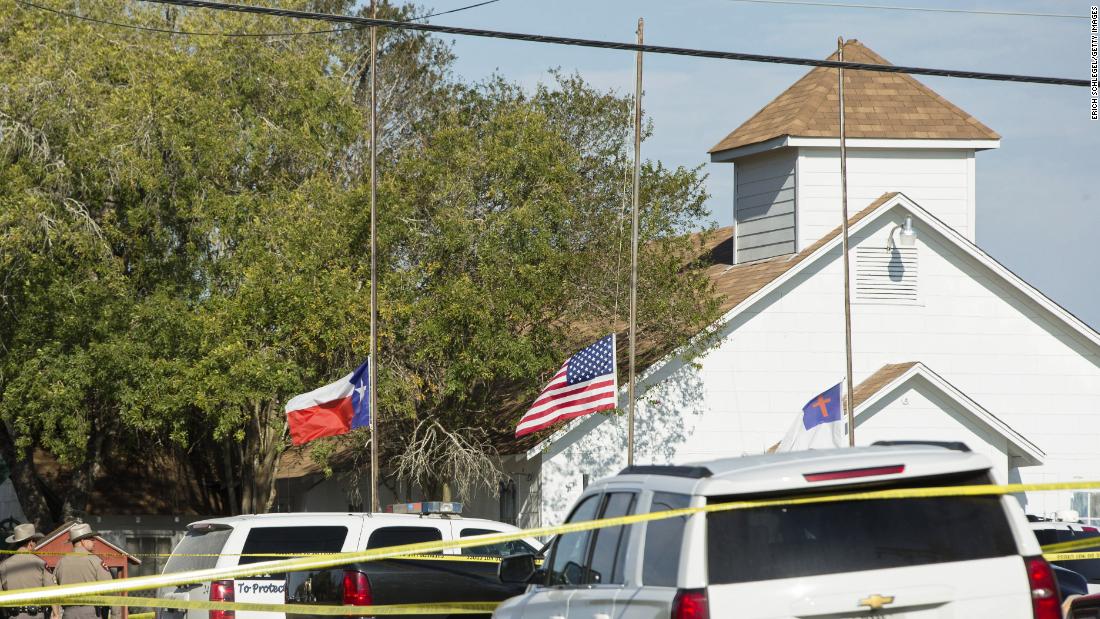
In the recent mass shooting at Sutherland Springs, Texas, the shooter (Devin Patrick Kelley) was taking out his frustration over a marital breakup on a church congregation of which his estranged wife and her extended family were members.

First Baptist Church at
Sutherland Springs, Texas

Did Kelley tend to "beat himself up" over his own inadequacies? We can never really be sure about that, but we can reasonably guess that Kelley's personal self-esteem had been wounded by the breakup of his marriage, that he was feeling separated and isolated from the rest of humanity, and that he was driven to his heinous deed by his overwhelming self-righteous anger. His ego and wounded self-esteem were in control of his actions. And Neff writes that "the relentless pursuit of self-esteem" is what drives our souls off-center:

Although thousands of [scholarly] articles [have] been written on the importance of self-esteem, researchers [are] now starting to point out all the traps that people can fall into when they try to get and keep a sense of high self-esteem: narcissism, self-absorption, self-righteous anger, prejudice, discrimination, and so on. ... self-compassion [is] the perfect alternative to the relentless pursuit of self-esteem.

Neff accordingly writes of the crucial importance of "staying centered." Her book is a guide to doing just that. Although it is not a religious book, it is in fact a spiritual one.

Hence my "yes, but" reaction to Bruenig's piece. I feel that our society and culture tend to push us away from our proper spiritual center. I am just realizing that I am quite off center, myself. Fortunately, my own off-centeredness doesn't incline me to gun violence. Yet I also realize that there are inevitably going to be those of us who cannot say the same, and who will pack heat as a way of coping with their antisocial feelings. One of these sick people was Devin Patrick Kelley.

Put in terms of "the good," what I am saying is that it is not really sane to consider the liberty to own guns as an absolute right, the philosophical search for "the good" notwithstanding, unless we also consider the desperate need for all of us — not to mention our culture as a whole — to find ways of being much more spiritually "on center" than we currently seem to be today.

Let us try self-compassion, then, and see whether it really leads us to true compassion for others and to being more "on center" spiritually.


Monday, November 06, 2017

Societal Dysfunction, the Alt-Right, Spirituality, and Following Your Bliss

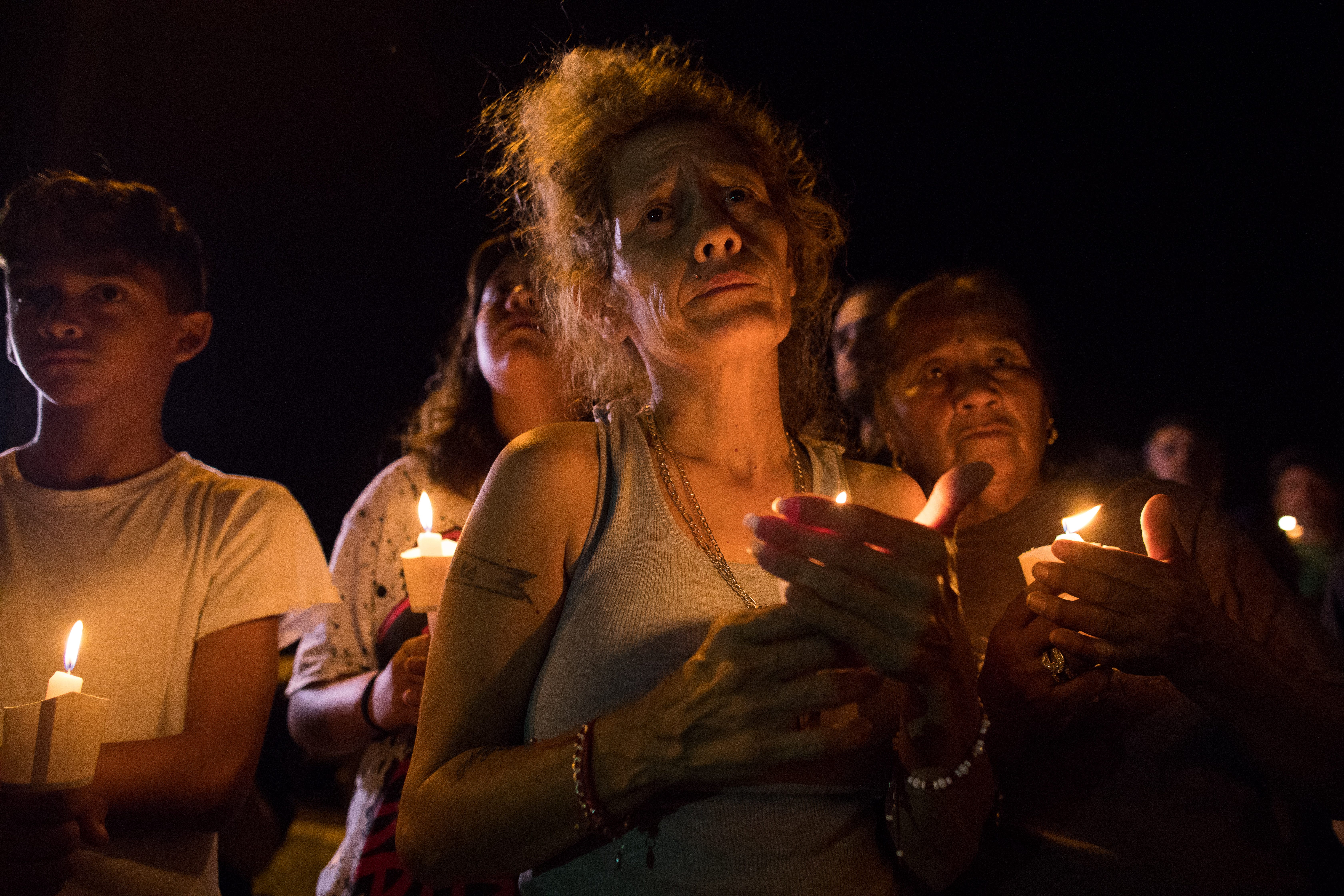
A headline at today's online New York Times: "‘Hero’ Bystander Shot at Texas Killer; 26 Dead at Church." The reference is to the shooting at the First Baptist Church in Sutherland Springs, Tex., which claimed the lives of 26 innocent people and ended with the death of the shooter himself. The hero in question was an unidentified bystander, a man who pursued the shooter and exchanged fire with him with his, the armed bystander's, own rifle.

Candlelight vigil following the
First Baptist Church shooting

The shooting was yet another sign of the burgeoning dysfunctionality within our society. Such awful things are happening more and more these days.

Looking for a solution to the gun violence problem, we've talked about passing tighter firearms laws. I support such measures, but I know they are politically impossible at this point. Besides, all this gun violence is but a symptom of things that are wrong with our society at a deeper level — at a spiritual level, I'd say.

By "spiritual" I mean something that taps into the universal human capacity that goes beyond the teachings of any particular organized religion. I mean what Rabbi Michael Lerner talked about in such books as his 2000 "Spirit Matters." A quote from Lerner:

Reality is much more complex than any judgment of right and wrong encourages you to believe. When you really understand the ethical, spiritual, social, economic, and psychological forces that shape individuals, you will see that people's choices are not based on a desire to hurt. Instead, they are in accord with what they know and what world views are available to them. Most are doing the best they can, given what information they've received and what problems they are facing.

We're encountering a potpourri of different world views in America today, which is one of the principal factors that blocks us off from attaining greater unity and harmony. One of the world views that is coming to the fore right now is that of the so-called "alt-right." In the Sunday Washington Post yesterday, I found a Carlos Lozada review of three new books about this phenomenon. "Where the alt-right wants to take America — with or without Trump" has it that the participants in the alt-right movement occupy "an alternative dimension, a mental space beyond fact or logic, where the rules of evidence are replaced by paranoia."

The alt-rightists are deemed, at least by their opponents (of whom I am one), to be white supremacists/nationalists. I'd accordingly say each of them must feel as if he (I use the pronoun because most are white males) is someone from whom something has been taken. They each feel as if their once-dominant culture has come under attack from the cultural left, with its insistence on the so-called "identity politics" that empowers nonwhites, immigrants, women, gays, and so on.

In other words, they feel as if society has herded them into some sort of cultural jailhouse. And it's true: the cultural left has pretty well established a new set of strictures on thought and behavior. The strictures are what's called "political correctness." The alt-rightists hate political correctness.


But that means there is a tendency for alt-rightists to be haters in general. Their vituperative online behavior — so-called "trolling" — bears witness to that. The Merriam-Webster Dictionary online offers this definition of "troll":

to antagonize (others) online by deliberately posting inflammatory, irrelevant, or offensive comments or other disruptive content

Hate is not a spiritual value. Rather, just as is the burgeoning gun violence in America today, it is symptomatic of a spiritual deficiency.

In 1949, Joseph Campbell wrote in his premiere book, The Hero with a Thousand Faces:

The usual hero adventure begins with someone from whom something has been taken, or who feels there is something lacking in the normal experience available or permitted to the members of society. The person then takes off on a series of adventures beyond the ordinary, either to recover what has been lost or to discover some life-giving elixir.

To Campbell, the "hero adventure" that is at the heart of much of the world's trove of mythological wisdom is a spiritual journey towards personal compassion, not hate. Vituperation and hate offer the hero no life-giving elixir, no vitalizing boon that the journeying hero can bring back to his troubled society to heal its wounds. Rather, said the late scholar of myth, the true path to spiritual elevation is for each potential hero among us to "follow your bliss."

"Follow your bliss and don't be afraid, and doors will open where you didn't know they were going to be," Campbell said. The things that initially may seem to be soul-strangling strictures imposed upon the individual by society are ultimately illusory. The hero's adventure takes him or her beyond the current politics or current sociology of his society to reveal a life-giving elixir that is compounded of courage and compassion. The pathway of vituperation and hate does not lead to such an elixir; that's one of the lessons taught by Jesus.

So, please, let's all look elsewhere than the alt-right for paths to America's spiritual healing. Let's all learn to go on a hero's journey and (what amounts to the same thing) to follow our bliss.


Sunday, October 29, 2017

More Profundity from David Brooks

Jonathan Sacks
New York Times columnist David Brooks says in "The Week Trump Won" that America was founded on a (however oxymoronic) "secular religion" that held that "the heart of society was in the covenantal realm: 'marriages, families, congregations, communities, charities and voluntary associations'," exactly as Rabbi Jonathan Sacks has recently pointed out. These are, Sacks says, values that derive from the Hebrew Bible, a.k.a. the Old Testament.

"America’s Judeo-Christian ethic," Brooks points out, "celebrated neighborliness over pagan combativeness; humility as the basis of good character, not narcissism. It believed in taking in the stranger because we were all strangers once. It dreamed of universal democracy as the global fulfillment of the providential plan."

The presidency of Donald Trump represents a complete upending of this foundational idea. Sacks has noted, "Today, one half of America is losing all [their erstwhile] covenantal institutions. It’s losing strong marriages and families and communities. It is losing a strong sense of the American narrative. It’s even losing e pluribus unum because today everyone prefers pluribus to unum ... ."

Don't miss reading Brook's full column about this ugly turn of events!


Tuesday, October 10, 2017

Has Change Come Too Fast?

Michael Gerson
Center-right Washington Post columnist Michael Gerson writes, in "The issue that is — unfortunately — uniting Americans on the left and the right," that Americans are mostly of one accord today ...

... in their belief that the United States is dominated by corrupt, self-serving elites. They are united in their call for radical rather than incremental change. While disagreeing deeply about the cause, they see America as careening off course. Little wonder that Americans consistently say their country in on the wrong track by a margin of more than 2-to-1. Disgruntlement is our nation’s common ground.

I think the disgruntlement stems from progressive changes happening too fast over the course of the last few years or decades.

I say this as a progressive Democrat who likes the progress we've made during the 70 years I've been around. To paraphrase Barack Obama: "[Each] successive generation [has indeed looked] upon our imperfections and decide[d] that it is in our power to remake this nation to more closely align with our highest ideals." Among the good things that have happened:


  • We've seen African Americans and other people of color get a fairer deal, in large part because of federal laws banning discrimination and ensuring voting rights.
  • We've witnessed women's gains in self-determination in our once-patriarchal society, due primarily to the liberation movement that began with the rise of second wave feminism in the 1960s.
  • Our world is now one in which the once generally mandated restrictions on individual sexual behavior have been lifted, thanks largely to the Sexual Revolution of that same decade.
  • We've progressed from a society of LGBT intolerance to one in which gays, lesbians, bisexuals, and transgender people don't have to hide their sexual and gender identities.
  • We now have a society in which everyone is truly free to practice the religion he or she prefers, or no religion at all.

These and others like them were epochal changes that happened stunningly fast.

Too fast, I think. There has been backlash. When epochal changes follow one another too rapidly, the culture gets indigestion. There are now just too many dyspeptic citizens who feel cruelly trampled over. They are the ones who voted a candidate like Donald Trump into the White House. Some of them even show their disgruntlement by painting swastikas and rallying for white supremacy.

So I think progressive change now needs to take a long nap. That's the only way we can bring people back together over something positive, rather than just over shared disgruntlement. It's the only way the center of our culture can begin to hold once more.


Sunday, October 08, 2017

Faith and Trust ... and Gun Violence

An article by historian Randolph Ross in today's Washington Post has it that there is a long historical connection between rises in people's tendency toward committing deadly acts of violence and people's having lost faith and trust in government. "How the erosion of trust leads to murders and mass shootings" details the way in which, as trust dissipates, killings rise.

Americans' trust in governmental leaders is at a low ebb. We've just seen, in Las Vegas, the worst mass shooting in our history. There's a connection, Roth maintains.

A makeshift memorial to those killed by Stephen Paddock
at the Route 91 Harvest Festival in Las Vegas.


This doesn't come as a big surprise. Whenever Americans have faith in those who lead them, each feels as if he or she comprises a distinct thread in a common flag.


Whether one is a red thread or a blue thread, each of us is best off when he or she knows it takes both colors to make an American flag.

We've lost that sense of unity today. What can we do to restore it? I think all of us need to work harder at restoring our one-time mutual dedication to civility.

According to the thesaurus, words closely related to civility include ...

... honors; ceremony, observance, rite, ritual; decorum, etiquette, form, manners, mores, proprieties; ... regards, respects; favor, grace, kindliness, kindness; protocol, rules

Let's all think about words like those and try to implement them in our lives once again! It may help put an end to all these unconscionable acts of deadly gun violence ...